Why your to-do app stopped working (it probably isn't you).
Yes, we make one. Here's what five studies say about why people quit their productivity tools.
It started as the perfect system. Projects, tags, priorities, a weekly review. Three weeks later there are 47 overdue tasks and you've stopped opening it. If your to-do app stopped working, research says the problem is usually the tool.
Feature fatigue
We pick products for what they can do, then find them hard to live with. Before use, capability weighs most. After use, usability does (Thompson, Hamilton & Rust, 2005). Every feature that sold you the app is one more thing to manage.
Upkeep kills tools
People abandon tools when keeping them up becomes unmanageable, when what they get out doesn't feel useful, or when the tool doesn't fit who they are (Lazar et al., 2015).
Everyone lapses
Stopping and starting again is a normal part of tracking anything (Epstein et al., 2015). A tool that punishes a gap makes the restart harder.
You're better at priorities than you think
People aren't bad at prioritising. Not every to-do is meant to get done (Bellotti et al., 2004). And many people make do with simple tools instead of elaborate systems (Haraty et al., 2012).
What a to-do app that lasts looks like
- It does less. A short list beats a complete one.
- It takes a minute a day. No weekly review to fall behind on.
- It expects days off. Rest is planned in.
- It lets things go. Old tasks can leave without guilt.
A to-do app built to be closed
offday has no projects, no tags and nothing to maintain. Plan the day in the morning, flip switches as you go, and take offdays whenever you need one. It's the to-do app you'll still open.
Download on theApp Store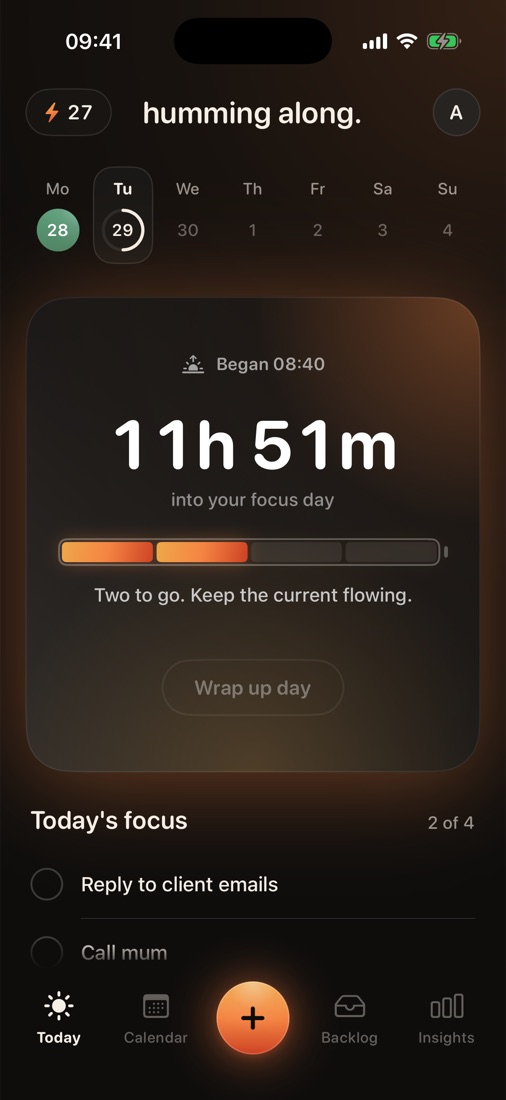
Sources
- Thompson, D. V., Hamilton, R. W., & Rust, R. T. (2005). Feature fatigue: When product capabilities become too much of a good thing. Journal of Marketing Research, 42(4), 431–442.
- Lazar, A., Koehler, C., Tanenbaum, J., & Nguyen, D. H. (2015). Why we use and abandon smart devices. Proc. UbiComp '15, 635–646.
- Epstein, D. A., Ping, A., Fogarty, J., & Munson, S. A. (2015). A lived informatics model of personal informatics. Proc. UbiComp '15, 731–742.
- Bellotti, V., Dalal, B., Good, N., Flynn, P., Bobrow, D. G., & Ducheneaut, N. (2004). What a to-do: Studies of task management towards the design of a personal task list manager. Proc. CHI '04, 735–742.
- Haraty, M., Tam, D., Haddad, S., McGrenere, J., & Tang, C. (2012). Individual differences in personal task management: A field study in an academic setting. Proc. Graphics Interface '12.