The planning fallacy: why you always plan too much.
There's waaaay too much on your plate. Here's how to plan a day you'll actually finish.
Nine things on Wednesday's list. Four get done. Sound familiar? The planning fallacy is our habit of underestimating how long things take, even when we've been wrong the same way before.
What is the planning fallacy?
It's the gap between how long we think a task will take and how long it really takes. The classic study asked 37 students to predict when they'd finish their thesis.
- Their average guess: 33.9 days.
- Their best case: 27.4 days. Their worst case: 48.6 days.
- How long it actually took: 55.5 days.
Only about 30% finished in the time they predicted, and the average was longer than their own worst case (Buehler, Griffin & Ross, 1994).
Why we keep doing it
When we plan, we picture the task going smoothly. We skip the interruptions, the slow bits, and every other time it took longer than we thought. Hope does the estimating.
How to plan a day you'll finish
Plan from your record. Look at what you actually got done on similar days and plan the next one to that.
If your last four Wednesdays held 4, 5, 4 and 5 things, plan 4 or 5 for this Wednesday. Plan 9 and you've lost before you start.
Insights learns what your days can hold
offday keeps an honest record of every day, then tells you what it can hold: Your Wednesdays usually hold 4 to 5, and Room for 2 more while you plan. Plan a day you can win.
Download on theApp Store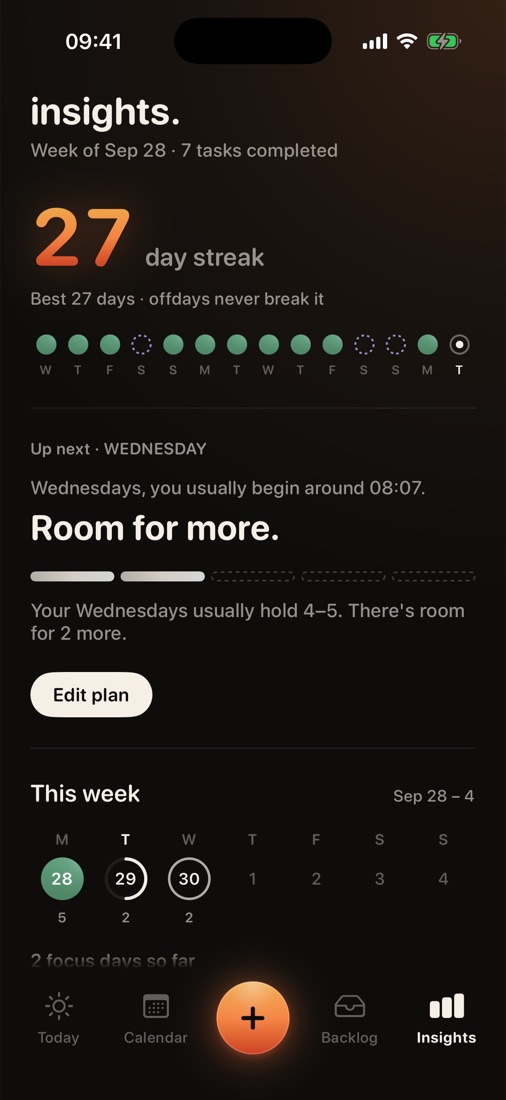
Sources
- Buehler, R., Griffin, D., & Ross, M. (1994). Exploring the "planning fallacy": Why people underestimate their task completion times. Journal of Personality and Social Psychology, 67(3), 366–381.