The what-the-hell effect: why one slip ends the whole plan.
You're on edge. Why you might want to cut yourself some slack.
One biscuit and the diet's over, so you eat the packet. One missed workout and the month is ruined. The what-the-hell effect is why the strictest goals are often the easiest to quit.
The milkshake study
In a staged taste test, people drank a milkshake and then sampled ice cream. Non-dieters ate about 47% less ice cream afterwards. Dieters, their rule already broken, ate about 66% more (Herman & Mack, 1975).
The researchers later named the thinking: "What the hell, my diet is already broken" (Herman & Polivy, 1980).
It's the feeling of having blown it
Later work found it's the feeling that does it. Everyone got the same slice of pizza, but dieters who were led to think theirs was bigger went on to eat more cookies (Polivy, Herman & Deo, 2010).
The fix: slack with a cost
In a month-long step challenge with more than 270 people, goals with two emergency skip days were hit on up to 40% more days than easy or rigid hard goals. People with reserves were also likelier to come back the day after a miss: 55% and 47% for the reserve groups, against 44% for easy goals and 37% for hard ones (Sharif & Shu, 2017).
So give a hard goal some slack, with a small cost, and a slip stops being the end.
Rest costs a day, not the streak
In offday, a day you don't begin is an offday. It doesn't add to your streak, and it doesn't break it. That's your slack, built in. Plan for the slip.
Download on theApp Store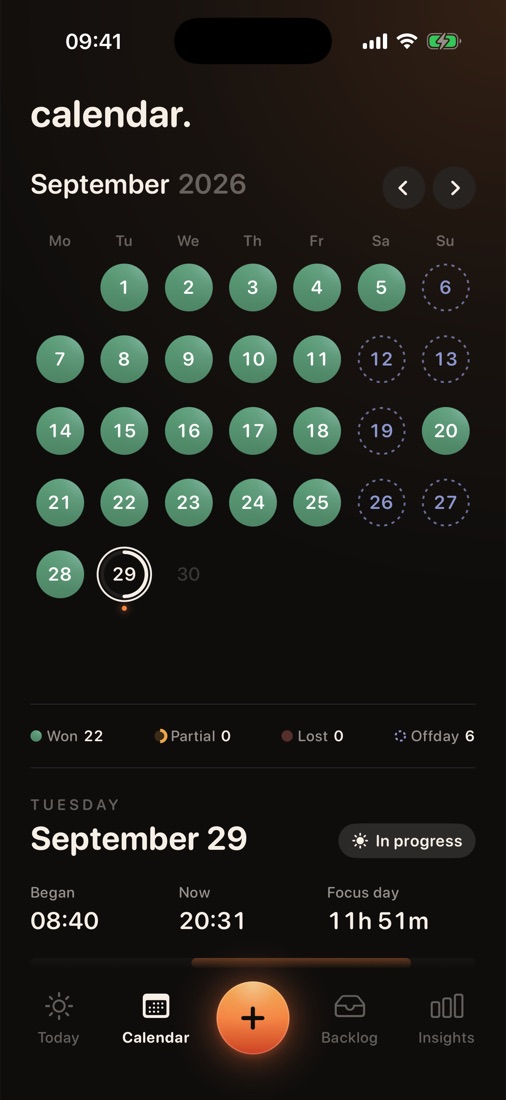
Sources
- Herman, C. P., & Mack, D. (1975). Restrained and unrestrained eating. Journal of Personality, 43(4), 647–660.
- Herman, C. P., & Polivy, J. (1980). Restrained eating. In A. J. Stunkard (Ed.), Obesity. Saunders.
- Polivy, J., Herman, C. P., & Deo, R. (2010). Getting a bigger slice of the pie: Effects on eating and emotion in restrained and unrestrained eaters. Appetite, 55(3), 426–430.
- Sharif, M. A., & Shu, S. B. (2017). The benefits of emergency reserves: Greater preference and persistence for goals that have slack with a cost. Journal of Marketing Research, 54(3).