Why unfinished tasks stay on your mind, and how to let them go.
That one small undone thing that follows you to bed has a name, and a surprisingly easy fix.
Renew the passport. Book the dentist. Fix the squeaky door. Tiny jobs, days old, and somehow they find you at 2am. Unfinished tasks stay on your mind in a way finished ones never do.
People often call this the Zeigarnik effect, after the psychologist Bluma Zeigarnik, who studied unfinished tasks in the 1920s. Newer research adds a twist worth knowing.
What an open loop does to your mind
An unfinished goal keeps part of your mind busy. In a set of experiments, people with a goal left open had more wandering thoughts, kept the goal top of mind, and scored worse on an unrelated puzzle (Masicampo & Baumeister, 2011).
The twist: you don't have to finish it
In the same research, people didn't need to complete the goal to stop the interference. Writing a specific plan they meant to keep was enough. "Thursday, 9am: call the passport office" did the job.
Your mind seems happy to let go once it trusts there's a plan.
Three honest options
For anything that keeps tapping you on the shoulder, pick one:
- Do it today. If it's small, just get it off the list.
- Plan it. A day and a time, written down.
- Drop it. Out loud. Some things were never going to happen, and that's allowed.
The backlog
offday's backlog is where tasks wait until you're sure about them. Park it there and it shows how long each one has waited, so the question becomes simple: do it, or drop it?
Download on theApp Store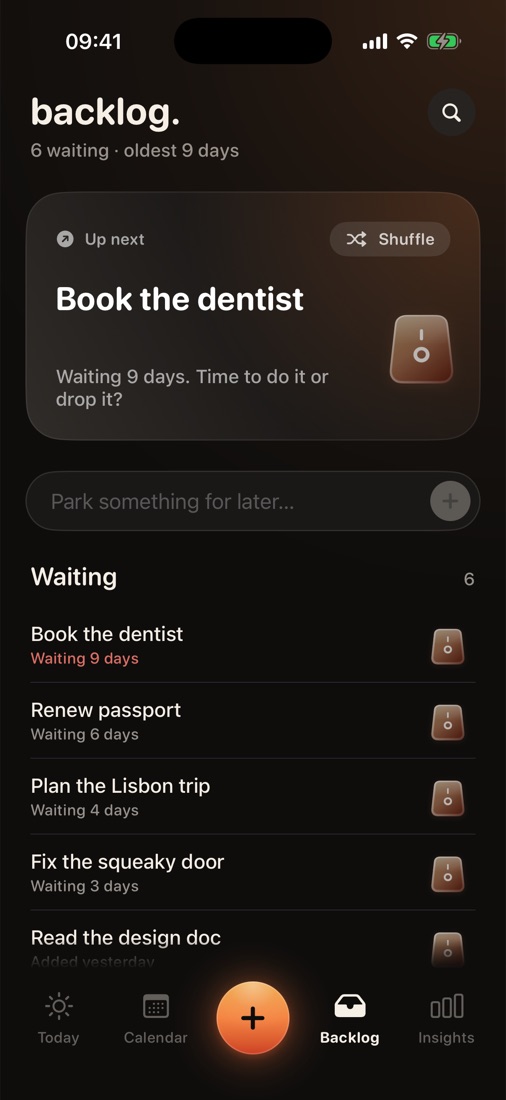
Sources
- Masicampo, E. J., & Baumeister, R. F. (2011). Consider it done! Plan making can eliminate the cognitive effects of unfulfilled goals. Journal of Personality and Social Psychology, 101(4), 667–683.