Write a to-do list before bed and fall asleep faster.
Can't switch off at night? A sleep lab tested the five-minute fix.
It's 11pm and your mind is still rehearsing tomorrow. Reply to Sam. Did I send the invoice? Book the dentist. Writing a to-do list before bed sounds too simple to help. A sleep lab says otherwise.
What the sleep study found
Researchers brought 57 young adults into a sleep lab. Before lights out, each spent five minutes writing. Half wrote a to-do list for the coming days. The other half listed what they'd already done.
The to-do group fell asleep faster. And the more specific their list, the faster they dropped off (Scullin et al., 2018).
Specific is the key word. "Work stuff" keeps your brain on duty. "Send Sam the deck by 10" lets it clock off.
Why writing it down helps
Unfinished tasks like to hang around in your head. A written plan seems to tell your mind that someone's got it, so it can stop rehearsing. There's more on that in why unfinished tasks stay on your mind.
A five-minute wind-down
- Glance at what's still open. No doing, just looking.
- Write tomorrow's few things, exactly. Who, what, by when.
- Close the list. Tomorrow holds it now. You don't have to.
Plan tomorrow
offday's Plan tomorrow is built for those five minutes. Set the next day's few things the evening before, then put the phone away. There are no notifications to pull you back.
Download on theApp Store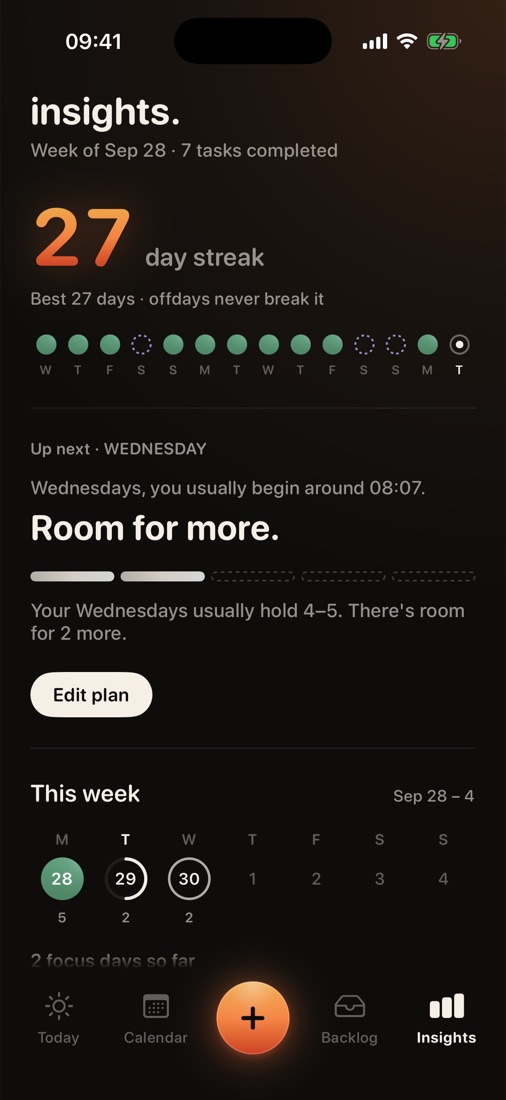
Sources
- Scullin, M. K., Krueger, M. L., Ballard, H. K., Pruett, N., & Bliwise, D. L. (2018). The effects of bedtime writing on difficulty falling asleep: A polysomnographic study comparing to-do lists and completed activity lists. Journal of Experimental Psychology: General, 147(1), 139–146.