End-of-day reflection: start with a one-sentence journal.
Your head is a terrible scratchpad. Write it down, and it pays off tomorrow.
Journaling has a reputation for blank pages and good intentions. But end-of-day reflection can be tiny and still be worth doing. One study put a number on it.
What the reflection study found
New call-centre staff spent the last 15 minutes of each training day writing about what they'd learned. After 10 days, they performed 23% better than colleagues who didn't (Di Stefano, Gino, Pisano & Staats, Harvard Business School working paper).
That's one field study, with its own people and its own job. The habit is the takeaway: stop, look back, write it down.
Start with a micro-journal
You don't need a notebook or 15 minutes to begin. One honest sentence at the end of the day is enough to build the habit. Try one of these:
- What powered today?
- What would I do differently?
- What did I learn?
Two deep work blocks before lunch. Phone in the other room. That's a whole journal entry.
Why it helps tomorrow
Reflection turns a blur of a day into something you can use. Write down what worked and you're more likely to do it again. Close the day with a statement, and tomorrow starts with one less question.
Mindlog
offday asks one question when the day is done, like What powered today?, and you answer in one line. It stays private, on your phone.
Download on theApp Store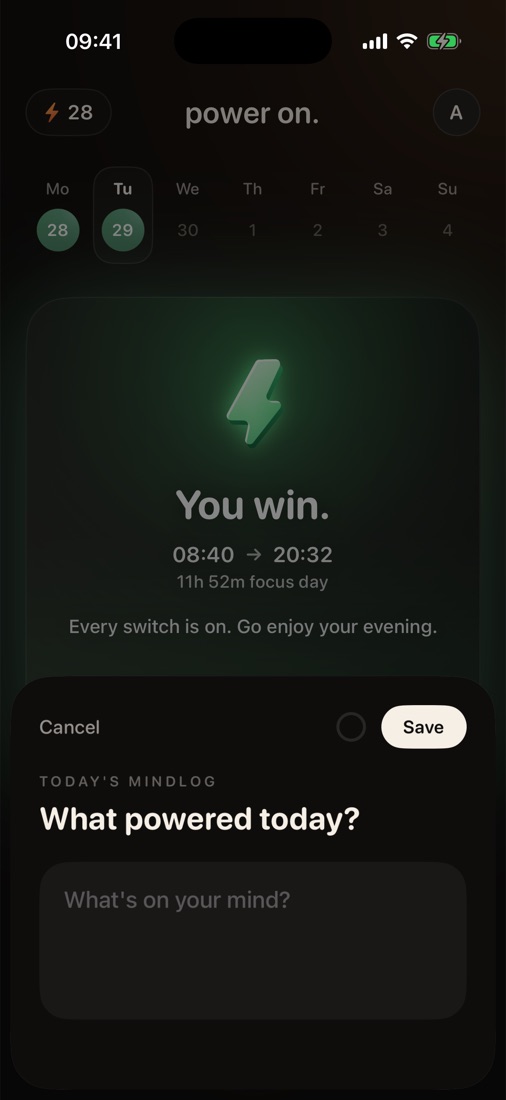
Sources
- Di Stefano, G., Gino, F., Pisano, G. P., & Staats, B. R. (2014). Learning by thinking: How reflection aids performance. Harvard Business School Working Paper 14-093. Earlier titled "Making experience count: The role of reflection in individual learning."