The goal-gradient effect: why the last task is the easiest to finish.
Speed is a state of mind. Why it gets easier the closer you get to the finish.
The last task on a list always goes quickest. That's the goal-gradient effect: the closer the finish, the faster we move. A coffee shop's loyalty card showed how strong it is.
The coffee-card study
In a café's buy-ten-get-one-free scheme, the time between purchases shrank by about 20% as customers got closer to their free coffee.
Then the twist. 108 customers got either a plain 10-stamp card or a 12-stamp card with two free bonus stamps already on it. Both needed ten coffees. The head-start group finished in 12.7 days, against 15.6 for the plain card (Kivetz, Urminsky & Zheng, 2006).
It's the share that's left
What pulls you forward is how much is left, as a share of the whole. Three done out of four feels nearly finished. Three done out of fifteen feels like you've barely started. Same work, very different pull.
How to stay close to the finish
- Keep the list short. Every task is a bigger slice of the day.
- Take a head start. Tick off a quick one first.
- Keep progress visible. You can't feel close to a finish you can't see.
Two to go
offday keeps today's list short and counts down with you as you go: Two to go. Flip the last switch and you win the day. Keep it short. Finish strong.
Download on theApp Store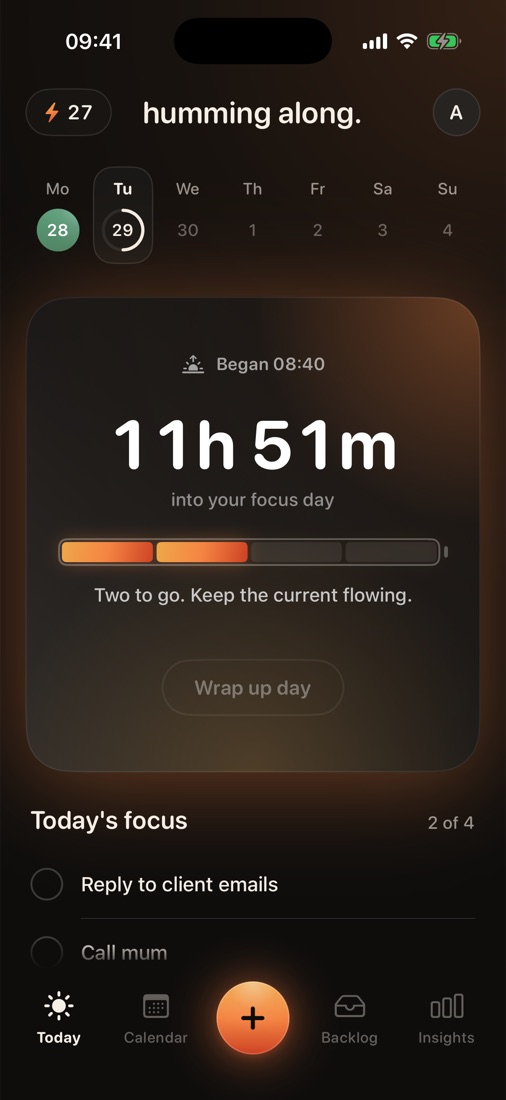
Sources
- Kivetz, R., Urminsky, O., & Zheng, Y. (2006). The goal-gradient hypothesis resurrected: Purchase acceleration, illusionary goal progress, and customer retention. Journal of Marketing Research, 43(1), 39–58.