The fresh start effect: you don't have to wait for January.
Every Monday is New Year's Day. The gym data backs it up.
New year, new you. Except January only comes round once. The fresh start effect says you get far more chances than that.
What is the fresh start effect?
Researchers looked at Google searches for "diet", gym visits and sign-ups to goal websites. All three rose after temporal landmarks: the start of a new week, month, year or semester, birthdays and holidays (Dai, Milkman & Riis, 2014).
Their suggestion: a landmark draws a line under the past. Last week's slip-ups belong to the last chapter, and the new one feels clean.
Landmarks are everywhere
- A Monday
- The 1st of the month
- A birthday
- The day after a holiday
- A new semester
- Tomorrow morning
You don't need a big one. A fresh week will do, and each morning is a small restart of its own.
How to use it
Pick the next landmark and tie your plan to it. "From Monday" works better than "someday". Then, when a day goes wrong, let the next morning be the next landmark.
Every day starts clean
In offday, each day gets its own result on the calendar, and anything unfinished goes back to the backlog. Yesterday stays in yesterday. Start fresh. No need to wait.
Download on theApp Store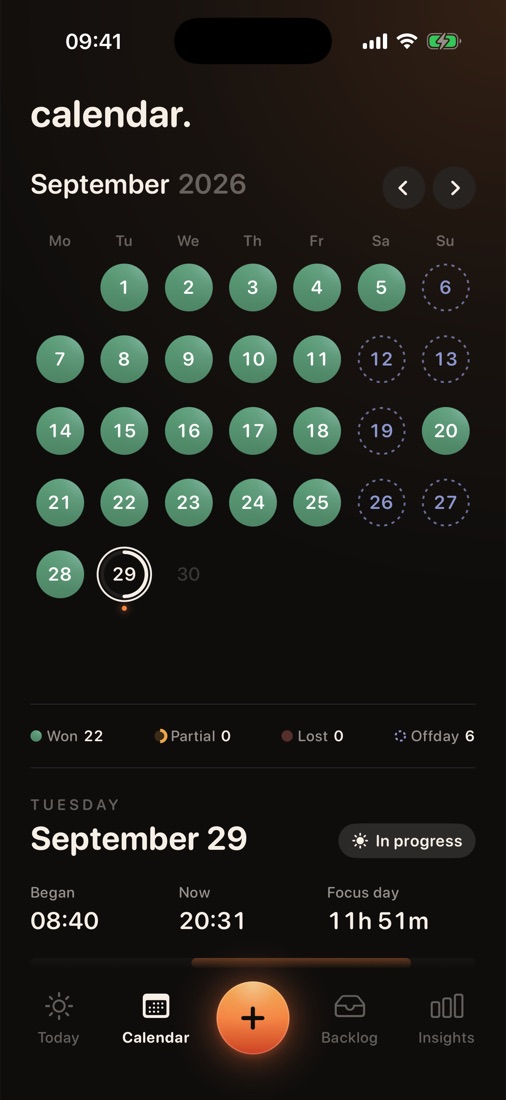
Sources
- Dai, H., Milkman, K. L., & Riis, J. (2014). The fresh start effect: Temporal landmarks motivate aspirational behavior. Management Science, 60(10), 2563–2582.